Drawing Connections:

The Country Wife (1675) + Rocky Horror Picture Show (1975)
Anyone who knows me in real life can attest that I have a fascination with both of these pieces of media. Both originally written as plays and adapted for the film camera, these two productions share a surprising amount of dramatic and thematic conventions. Despite the 300 year gap between the two productions, I am determined that there is a common thread connecting my obsessions with these two stories.
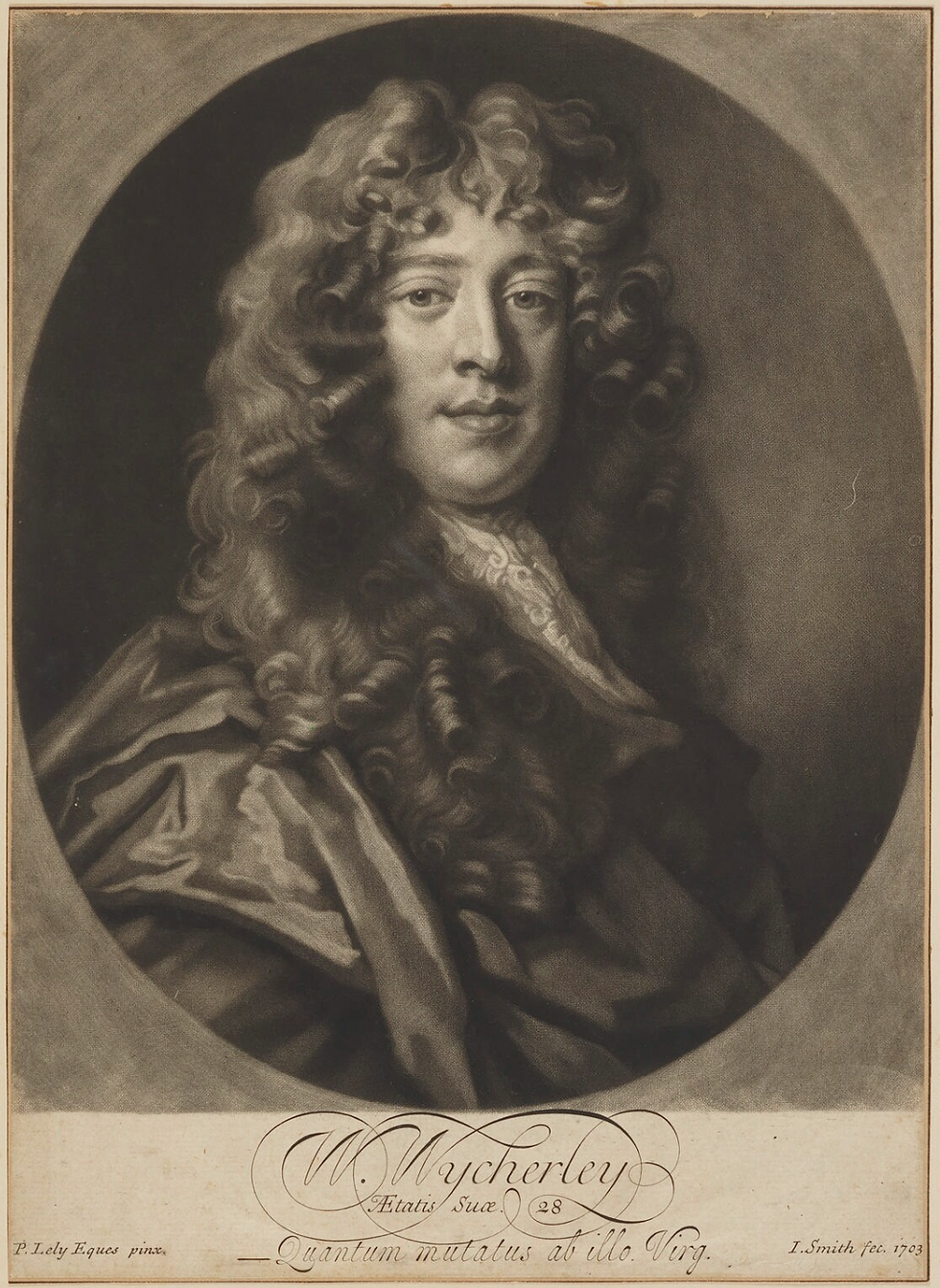
I first read William Wycherley's play, The Country Wife, in a long-18th century English literature course at Boston College (shoutout Prof. Mitsein!). Written originally in 1673 and performed for the first time in January of 1675, The Country Wife is the pinnacle of classic Restoration Comedy, a genre I became fully enthralled with. The Country Wife was most famously adapted into a BBC "Play of the Month" special, starring Helen Mirren in 1977.
I have watched the Rocky Horror Picture Show starring Tim Curry at least 30 times, marveling in the fantasy of Science-Fiction-Double-Feature. The Picture Show followed the original play and stage production, The Rocky Horror Show, written and performed first in 1973. By 1975, many of the actors from the stage production, including Richard O'Brien (the author himself!), had been cast in the screen-production of the 1975 film.

The Restoration years of the English monarchy and the dynamic 1970s of the Western world share popular breakthroughs of individuality and personal liberation.
Wycherley's The Country Wife (1675)
This is, by and large, my favorite play for a multitude of reasons, perhaps the most prominent reason being its stark contrast from plays just a decade prior and after. As mentioned, I was first exposed to this piece within a long-18th-century literature syllabus.
There are several changes which came to the screen-production, such as the complete removal of peripheral characters such as Dorilant. Trade-offs like these exemplify how the play was simplified for a shorter-form production. As with any creative decision, the benefits and drawbacks of something like this are subjective: Dorilant's absence, for one, lessens the prominence of the boys' club attitude, a prominent thematic feature in the literature.
While indisputably more effective in its original written form, the 1977 production of this play has gotten stuck in my mind like an advertising jingle.
Another factor which largely altered the presentation of this plot is the replacement of audience interaction with favor to the camera and television audience. For example, in one scene, Horner breaks the fourth wall, gazing into the lens before remarking, "Stay, the postscript," as a direct address to the audience as he reads a letter (approximately 1 hour and 20 mins into the BBC recorded play). This acts like a modern interpretation of the comedic style present at Wycherley's debut, where playgoers were not safe from the actors' ridicule any more than the fops on stage.
As will be seen also with RHPS, the film-adaptation greatly benefitted from the luxury of a full set, rather than a stage façade, immersing characters and audience alike within their desired environment.
O'Brien's Rocky Horror Picture Show (1975)
I am admittedly far less familiar with Richard O'Brien's original Rocky Horror Show stage play than I am with Wycherley's. The 1975 production of the story by Lou Adler stars Tim Curry, Little Nell, and Patricia Quinn, among other original actors from the stage play. It is dually bolstered by new screen actors, such as Susan Sarandon and Meatloaf in popular roles.

The popularity of the RHPS subculture is an entire discussion in itself, from the evolution of shadow-cast performances, to audience props and costumes, to the ever-popular midnight showtime.
While I most certainly will dive into that topic at some point, it is not this blog post's aspiration. Rather, now that the context around the film productions of both The Country Wife and RHPS have been established, I would like to dive in to several common themes between the two, suggesting the timelessness and unchanging allure of media which discusses taboo topics.
Sexual Liberation
"Give yourself over... to absolute pleasure..." croons Dr. Frank-N-Furter in RHPS's most climactic scene, the floor show, reflecting his contrast from the straight-laced couple, Brad and Janet.
Likewise, The Country Wife separates action into two buckets, business and pleasure, attributing the former to the men and the latter to the women. This is thrown awry when confronted with a character like Harry Horner. The uptight old Pinchwife remarks sourly, " I have business, sir, and must mind it; your business is pleasure, therefore you and I must go different ways" (Act III Scene 2).
Both of these stroies detail the corruption of innocence and the dangers of reckless liberation. In Wycherley's time, the English monarchy had just been restored, a major transformation after the Puritanical tyrrany of the English Civil war. King Charles II of Great Britain was a known libertine, setting an example for better or worse about sexual revolution in a post-civil-war country and within the greater context of 17th century Europe. While drastically different in the specifics, the American 1970s act as a similarly transformative decade to the 1670s, reflecting clashing cultures of activism, radicalism, and personal liberation. Taking this into account, it also gives credence to the fact that the above-referenced 1977 BBC production of The Country Wife was produced in the same sexually liberal decade.
One particularly similar facet is the sexual revolutions central to the creation of both of these art pieces. Reflective of the rapidly changing world around them, these plays both reckon with the threat that atypical sexual expression offers, and question the rewards and consequences of succumbing to one's own desire.
Costume & Cross-Dressing
Another element which is beautifully consistent over time in these two productions is the gender play and use of disguise. First, let's talk about deciet and costumes, since it is, in my opinion, the most stunning similarity. In Wycherley's play, Marjorie, the country wife, is disguised as a boy in order to be brought to town. Her husband, Pinchwife, foolishly thinks that this disguise will protect her from the peering eyes of Horner. The younger gallant immediately sees through the costume, yet pretends he is oblivious in order to kiss and hug Marjorie without consequence. The trickery here is used for the purpose of sexual fulfuillment, as alluded to by this scene:
"Re-enter Mrs. Pinchwife (Marjorie) running, with her hat full of oranges and dried fruit under her arm, Horner following.
Marj. O dear bud, look you here what I have got, see!
Pinch. And what I have got here too, which you can't see! [Aside, rubbing his forehead]
Marj. The fine gentleman has given me better things yet.
Pinch. Has he so?—[Aside.] Out of breath and coloured!—I must hold yet.
Horn. I have only given your little brother an orange, sir.
Pinch. [To Horner.] Thank you, sir.—[Aside.] You have only squeezed my orange, I suppose, and given it me again; yet I must have a city patience."
(Act III Scene 2)

In an equally comedic scene, disguise is used in the Rocky Horror Picture Show during the bedroom scenes, even more audacious since the same joke series is repeated back-to-back two times. After Brad and Janet are shown to their separate rooms to sleep, there is a sequence in which Frank-N-Furter enters the bedroom in disguise, fooling one partner into believing they were snuggling up next to their betrothed. Soon, the ruse is discovered, yet both Brad and Janet decide to go ahead with Frank-N-Furter anyway. The trick with its iconic dialogue, is now immortalized even in cartoon (right).
The other half of this conversation is the gender-bending present in both these sequences. In The Country Wife, Marjorie is masculinized by her costume, but then Horner is also thrown into an effeminate light, engaging with a "boy" in his sexual advances. This ties back to the stereotype of the cuckold which Horner built his entire scheme upon: by pulling back on his masculinity in public, he is able to flex it in private with more freedom. The cuckolded men in the play can be seen as limited by their own definitions of masculinity and heterosexuality, while Horner and Marjorie are unafraid to bend the rules, and thus, can receive extra benefit.
The overarching message within the Rocky Horror Picture Show is exactly that as well: Brad and Janet are restricted by their narrow understandings of love, sex, and marriage. With Frank-N-Furter's gender fluidity, he challenges Brad and Janet's sexualities and attractions, revealing the spectrum of human desire as an empowering quality, not an abnormality.
The Dance of the Cuckolds
The dance of the cuckolds is a plot element used within Restoration Comedy, and is three-fold in its symbolism, as explored by David Gelineau in their 2014 article, "The Country Wife, Dance of the Cuckolds," (Comparative Drama: Vol. 48: Iss. 3, Article 5.) The Country Wife is generally viewed as the most classic example of this type of ending.
First, "the dance mockingly represents the two literal cuckolds—Pinchwife and Sir Jasper—standing on the stage watching it," reiterating the central action of the plot.
The second level of the symbolism, according to Gelineau, is that "All social relations, not only marriage, are shown to be cheats to those who trust them; consequently, all (or almost all) the characters on the stage are figurative cuckolds."
Lastly, and most closely related to my theory of connective tissue is the play's own self-awareness: "as the characters watch the performance, they are symbolic stand-ins for the audience, and the dancers are the stand-ins for the characters in the play, thereby showing that the play has been a mirror held up to its audience." (Gelineau, David. "The Country Wife, Dance of the Cuckolds." Comparative Drama 48, no. 3 (2014): 277-305. https://dx.doi.org/10.1353/cdr.2014.0024).
I feel confident applying the "Dance of the Cuckolds" label onto the floor show at the end of RHPS. In the same way that Gelineau argues their second tenet, that all social relations in The Country Wife are cheats to those who trust them, the characters who swim and kiss one another at random to the music of "Rose Tint My World" are cuckolding one another. Janet has betrayed Brad, Brad has betrayed Janet, Rocky has betrayed Frank, and Frank has betrayed Columbia. And yet, under the influence of "absoloute pleasure," those social rifts dissolve. This connects to the third level of symbolism again, as the movie turns the spotlight onto the audience by the end of the movie, reminding us that Brad and Janet could have been anyone watching from the other side just as easily.
Drawing Conclusions:
Restoration Comedy is a fantastically specific niche of satire, a method by which the English people coped with the massive political and social upheaval which tormented them throughout the 17th century. There were questions arising around morality, religion, virtue, truth, and sexuality which could no longer be ignored. In many ways, Restoration Comedy is the subculture, or underbelly of social-life at the time. This term, subculture, is more commonly associated with Rocky Horror, since it has accrued a cult-following over the years. But both plays capture a similar cultural moment and attempt to do the same thing as a way of understanding it: to turn the difficult conversations into a palatable, enjoyable comedy.
I could ramble on about these two plays in conversation for a long time, but this article has stretched on a bit already. Instead, I will leave you with a beautiful quote from Tim Curry (RIP) captured by BBC during the 1974 filming of the RHPS movie:

"It is parody, but also I play it and think it as a kind of grisly reality. And Frank-N-Furter, as a variation on Frankenstein, is obsessed with image and the way that things look. But I see him, and play him as a kind of grisly, real freak."